What Is GPU Memory Bandwidth and Why Does It Matter for Gaming?
Introduction
GPU memory bandwidth is the rate at which a graphics processor can exchange data with its external memory. Games constantly read textures and other resources and write rendering results. When a workload moves large amounts of data, bandwidth can influence performance. However, not every game is limited by memory bandwidth. Shader throughput, CPU performance, cache, memory capacity, and engine design can be equally or more important.
A clear explanation of GPU architecture should connect the specification to the way software uses the hardware. Names such as memory bus, cache, unified memory, and bandwidth can sound similar, but they describe different parts of the system. This guide defines the central terms, explains their relationships, and gives readers a practical framework for evaluating graphics cards and workstations.
| Factor | How it affects bandwidth demand |
|---|---|
| Resolution | Higher resolutions increase pixel counts and can increase render-target traffic |
| Texture quality | Affects asset size; sampling patterns affect how often data is fetched |
| Cache | Reusing data from cache reduces repeated external reads |
| Compression | Reduces the number of bytes moved for supported resources |
Quick answer
Bandwidth can matter when a game moves large amounts of data, but it is not a universal FPS rating. Compare complete GPU benchmarks at the resolution and settings you use.
Background: how a GPU uses memory
A graphics processor executes many operations in parallel. It needs a steady supply of data, including textures, geometry, frame buffers, model weights, and intermediate results. Local graphics memory provides a large working area, while caches keep selected data closer to processing units. The memory controller coordinates access, and the external interface determines how data moves between the GPU and memory devices.
The system is a hierarchy. Different resources have different sizes, lifetimes, and access patterns. Some are reused across many frames or operations, while others are temporary. The software engine, driver, and hardware cooperate to allocate, stream, cache, and release resources. This is why memory use can change as a scene or workload changes.
Why games need bandwidth
The GPU reads texture data, depth information, geometry resources, and other assets while producing frames. It also writes render targets and intermediate results. The volume and pattern of these transfers vary by game, resolution, effects, and engine. High-throughput memory helps supply the GPU when external data movement is a major part of the workload.
How bandwidth is calculated
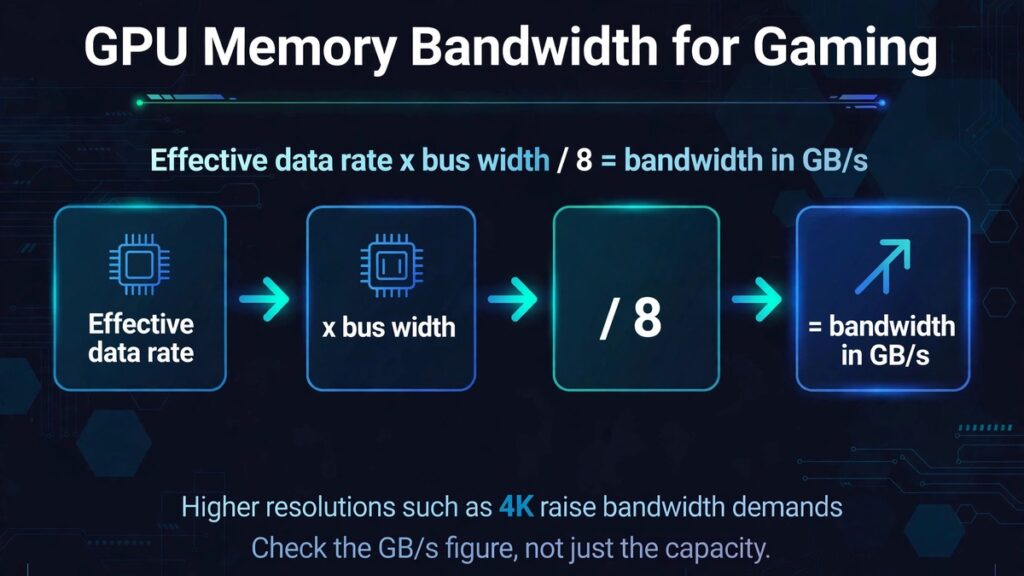
A simplified theoretical bandwidth calculation uses effective memory data rate multiplied by bus width, divided by eight to convert bits to bytes. Manufacturers often list the resulting figure in GB/s. The number is a theoretical interface rate and does not mean every game continuously achieves that throughput.
Resolution and bandwidth
Higher resolutions increase pixel counts and can increase the size and traffic of render targets and other pixel-related resources. The impact depends on the rendering pipeline. A higher resolution also increases shader work, so a performance drop cannot automatically be attributed to bandwidth.
Textures and bandwidth
Textures are read by shaders and sampling units. Texture quality can affect the size of assets, while sampling patterns influence how frequently data is fetched. Cache can reduce repeated external reads. A game may be capacity-limited by large assets or bandwidth-limited by the rate of data access; those are different conditions.
Cache and compression
Cache can keep frequently accessed data close to the GPU and reduce external traffic. Compression can reduce the number of bytes moved for supported resources. These features improve effective memory-system efficiency, which is why raw bandwidth figures do not always predict game performance.
How to test bandwidth sensitivity
Compare performance at consistent settings and use cards with similar GPU processing capability where possible. Memory overclocking can be a diagnostic, but it must be stable and repeatable. Observe whether performance changes with memory data rate while GPU core settings remain fixed. Even then, ensure that the result is not caused by measurement noise or thermal variation.
Buying for gaming
Consider the target resolution, games, memory capacity, bandwidth, GPU architecture, cache, and price. A card with high bandwidth but insufficient VRAM may still require texture compromises. A card with sufficient memory but weak compute performance may struggle at high settings. Review independent benchmarks that match your use case.
How to use this information when comparing hardware
Start with the exact product model, not just the GPU family name. Check the official product page for capacity, memory type, bus width, data rate, bandwidth, and architecture. Product variants can have different specifications even when they share a similar name. Confirm whether a listed value applies to the desktop card, laptop version, or a partner-board model.
Then match the comparison to your workload. Gaming tests should use the resolution and settings you expect to play. AI tests should identify model size, quantization, context length, and inference framework. Workstation tests should use representative project files and application versions. A specification may be important in theory but have little effect in a workload limited by another component.
Finally, look for transparent methodology. A benchmark should state the system, software versions, settings, test route, and measurement method. If the article uses a theoretical calculation, show the formula and assumptions. Do not present estimates as measured results. Repeated tests and clear limitations make the conclusion more useful.
Common misconceptions
More VRAM does not automatically mean more FPS. Shared memory is not always equivalent to dedicated VRAM. A higher memory clock is not the same thing as higher bandwidth. A wider bus does not guarantee a faster GPU. Cache does not replace the main memory pool. These distinctions matter because each specification describes a different part of the system.
Frequently asked questions
Does higher bandwidth increase FPS?
It can help bandwidth-sensitive games, but many titles are limited by other parts of the GPU or system.
Is 500 GB/s enough for gaming?
There is no universal threshold. Requirements depend on GPU architecture, resolution, cache, game, and settings.
Does a wider bus always mean more FPS?
No. It can increase theoretical bandwidth, but other architecture features and compute performance matter.
Can memory overclocking help gaming?
It can improve some bandwidth-limited workloads, but gains vary and stability must be verified.
Is bandwidth more important at 4K?
Higher resolutions can increase data traffic, but the overall bottleneck depends on the GPU and game.
Conclusion
Bandwidth is important when data movement limits the GPU, but gaming performance is the result of the entire rendering system.
The most useful GPU comparison is one that connects specifications with a real workload. Understand what each memory metric describes, check exact manufacturer information, and use repeatable application tests. This gives readers a reliable way to judge hardware without relying on a single headline number.









