What Is a GPU Memory Controller?
Introduction
A GPU memory controller manages communication between the graphics processor and its external memory. It coordinates memory requests, schedules access, and helps move data between VRAM and the GPU's processing units. Its design influences how efficiently the GPU uses available bandwidth and handles concurrent requests. The controller is one part of the memory subsystem, working alongside memory chips, cache, compression, and the GPU architecture.
Technical specifications become meaningful when readers understand what the component does, how it interacts with the rest of the GPU, and which workloads benefit from it. This guide explains the concept in practical terms, separates related terms that are often confused, and outlines how to evaluate the feature in a real graphics card or workstation. No single specification should be treated as a complete prediction of performance.
| Role | What the article says |
|---|---|
| Traffic manager | Coordinates data transfers between the GPU and VRAM |
| Scheduler | Schedules access across memory channels; a wider interface can provide more bandwidth at a given data rate |
| Cache partner | Caches can satisfy repeated requests without reaching external VRAM, reducing traffic through the controller |
| Not a capacity control | Does not determine VRAM capacity — that depends on the installed memory devices |
Quick answer
The memory controller coordinates data transfers between the GPU and VRAM. Its design helps determine how efficiently the card uses its memory interface, but overall performance also depends on data rate, bus width, cache, and workload.
Core concepts
A GPU is a collection of specialized processing units connected to a memory hierarchy, command and scheduling systems, caches, and external interfaces. Graphics and compute workloads generate requests for data, perform operations, and write results to memory. The efficiency of this process depends on locality, data format, concurrency, and the design of the hardware and software.
It is useful to distinguish local storage capacity, transfer bandwidth, cache behavior, and compute throughput. Capacity determines how much data can be retained. Bandwidth determines how quickly data can move. Cache can keep frequently accessed information close to processing units. Compute throughput determines how quickly the GPU performs operations. A feature may improve one part of the pipeline without changing the others.
Where the controller sits
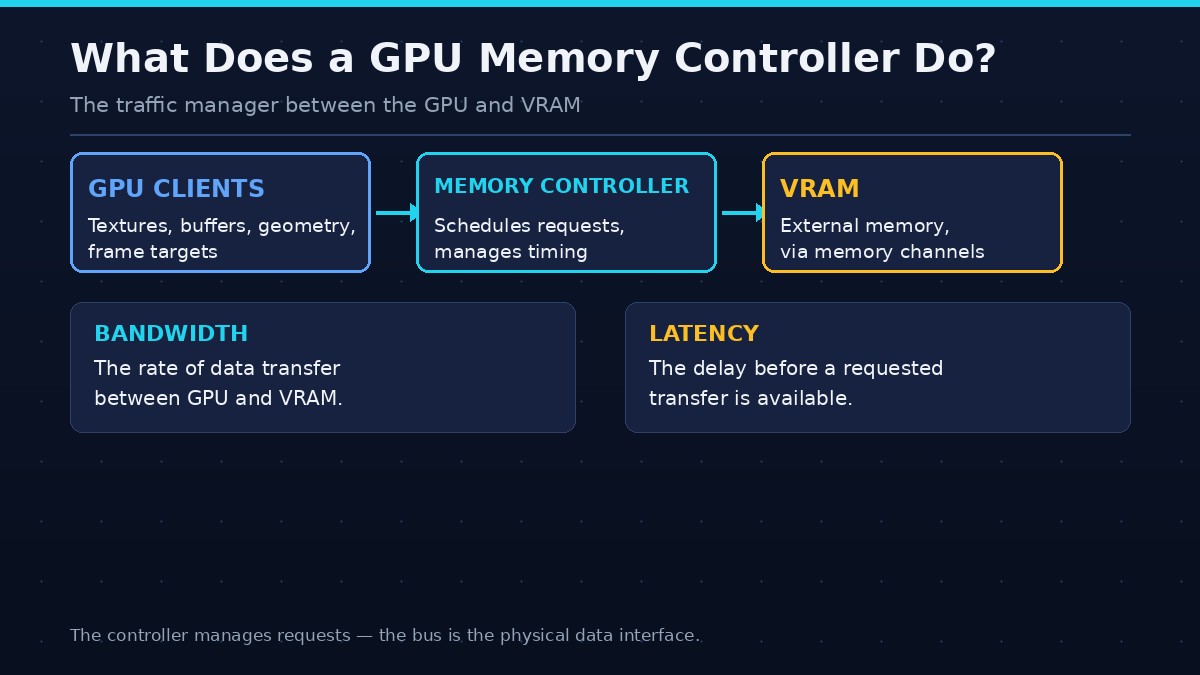
The memory controller is part of the GPU's memory subsystem. It communicates with external memory devices through physical interfaces and coordinates requests from different GPU clients. The exact organization differs by architecture, including the number of channels, partitions, and internal scheduling mechanisms.
What requests it handles
Graphics and compute units request data for textures, buffers, geometry, frame targets, and other resources. Many requests may be outstanding at once. The controller helps schedule access and manage timing constraints so that memory devices can serve requests efficiently.
Channels and bus width
Memory channels and the aggregate bus width determine how much data can be transferred in parallel. A wider interface can provide more bandwidth at a given data rate. The controller must coordinate requests across the available channels. Product specifications typically report the aggregate interface width rather than every internal detail.
Latency and bandwidth
Bandwidth describes the rate of data transfer, while latency describes the delay before a requested transfer is available. A workload can be sensitive to either or both. High bandwidth does not eliminate latency, and cache can reduce the number of external requests when data is reused.
Scheduling and access patterns
The controller can improve efficiency by organizing requests and taking advantage of available memory parallelism. Workloads with many independent requests may use bandwidth differently from workloads with scattered or dependent accesses. The GPU architecture and application determine how effectively requests can be issued and overlapped.
How cache supports the controller
Caches can satisfy repeated requests without reaching external VRAM. This reduces traffic through the memory controller and can improve effective bandwidth. Cache misses still require lower-level memory access. The size and design of cache, compression, and controller all influence memory behavior.
Why buyers rarely compare controllers directly
Manufacturers do not always publish detailed controller internals in consumer specifications. Buyers can evaluate the resulting memory bandwidth, architecture, cache, capacity, and application benchmarks. A theoretical controller feature is less useful than evidence of how the complete GPU performs.
How to evaluate it
Start with the exact product documentation. GPU features can differ between architectures, product tiers, and even variants within a product family. Check the manufacturer's specification page and technical documentation rather than assuming that a feature name has identical behavior on every generation. When an application exposes a setting related to the feature, review the application's own documentation as well.
Next, identify the workload. A feature may matter greatly in one game or rendering engine and have little visible effect in another. Compare controlled tests using the same software version, scene, resolution, quality settings, and system configuration. If a benchmark changes several variables at once, it cannot isolate the effect of the feature.
Finally, report the limits of the comparison. State whether the result is a measured application benchmark, a theoretical calculation, or a description based on manufacturer documentation. Avoid assigning a performance percentage to a feature without a reproducible test. The goal is to help readers understand where the feature matters, not to imply that a single specification guarantees a specific frame rate.
Common misunderstandings
A newer architecture does not make every older product obsolete for every workload. A larger number in a specification table does not automatically translate into better application performance. Features may be supported differently by software, and driver updates can change behavior. A benchmark result from one game should not be generalized to all games or creative applications.
Frequently asked questions
Does the memory controller determine VRAM capacity?
No. Capacity depends on the installed memory devices and product design. The controller manages access to that memory.
Does a better memory controller increase FPS?
It can improve memory efficiency in some workloads, but overall FPS also depends on compute, bandwidth, cache, and software.
Is the memory controller part of the GPU?
In modern discrete GPUs, memory-controller logic is integrated into the GPU architecture, though exact designs vary.
What is the difference between memory controller and memory bus?
The controller manages requests and communication; the bus is the physical data interface used to transfer bits.
Can I upgrade a GPU memory controller?
No. It is part of the GPU hardware design.
Conclusion
The memory controller is the traffic manager for VRAM. Its value is best understood through the complete memory subsystem and measured application behavior.
Use the feature as one part of a broader evaluation. Check exact compatibility, understand the workload, and rely on repeatable tests when comparing products. A technically accurate explanation should show both the benefit and the conditions under which that benefit may not appear.