
Dedicated VRAM vs Unified Memory: What’s the Difference?
Introduction
Dedicated VRAM and unified memory describe different approaches to providing data to CPUs and GPUs. A discrete graphics card typically has its own local memory, while a unified memory architecture allows CPU and GPU components to access a shared physical memory pool. The distinction affects data movement, capacity planning, bandwidth, and software design. Neither approach is automatically superior for every workload; the right choice depends on the hardware architecture and application.
Technical specifications become meaningful when readers understand what the component does, how it interacts with the rest of the GPU, and which workloads benefit from it. This guide explains the concept in practical terms, separates related terms that are often confused, and outlines how to evaluate the feature in a real graphics card or workstation. No single specification should be treated as a complete prediction of performance.
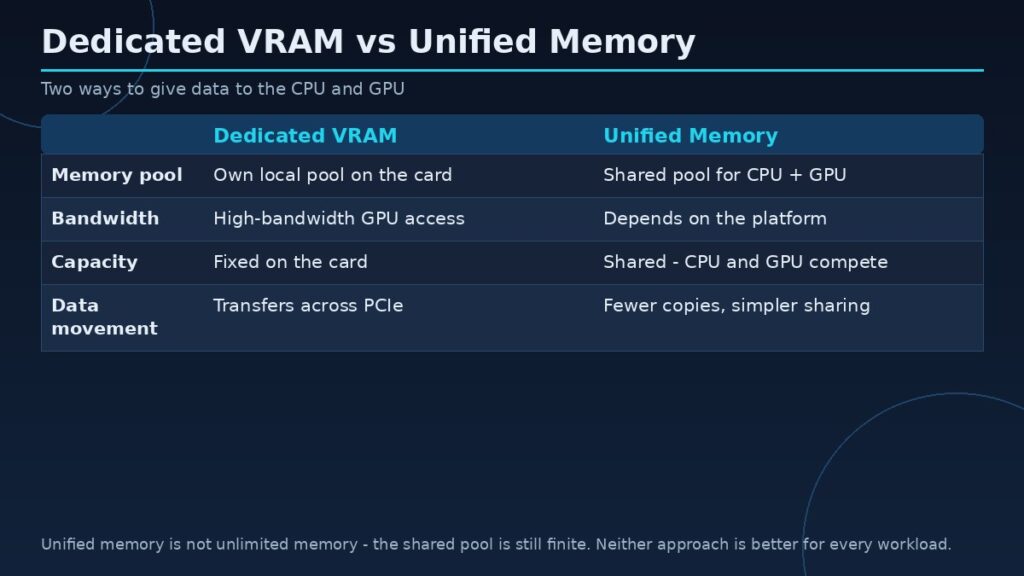
| Aspect | Dedicated VRAM | Unified memory |
|---|---|---|
| Memory pool | Its own local memory pool on the discrete card | A common physical memory pool shared by CPU and GPU components |
| Data movement | CPU and GPU may need transfers across an interconnect such as PCIe | Can reduce the need to maintain separate copies of some data |
| Capacity limit | Fixed capacity on the card | Finite shared pool; CPU and GPU workloads compete for capacity |
| Bandwidth | Local memory designed for high-bandwidth GPU access | Depends on the platform; contention may occur when both processors use memory heavily |
Quick answer
Dedicated VRAM gives a discrete GPU its own local memory pool. Unified memory architectures let CPU and GPU components share a common physical memory pool, potentially reducing some copies, but bandwidth and capacity are still limited by the platform.
Core concepts
A GPU is a collection of specialized processing units connected to a memory hierarchy, command and scheduling systems, caches, and external interfaces. Graphics and compute workloads generate requests for data, perform operations, and write results to memory. The efficiency of this process depends on locality, data format, concurrency, and the design of the hardware and software.
It is useful to distinguish local storage capacity, transfer bandwidth, cache behavior, and compute throughput. Capacity determines how much data can be retained. Bandwidth determines how quickly data can move. Cache can keep frequently accessed information close to processing units. Compute throughput determines how quickly the GPU performs operations. A feature may improve one part of the pipeline without changing the others.
Dedicated VRAM architecture
A discrete GPU usually has memory chips connected directly to the graphics processor. This local memory is designed for high-bandwidth GPU access. The CPU and GPU may need to transfer resources across an interconnect such as PCIe, depending on the workload. Dedicated memory can provide strong GPU bandwidth but has a fixed capacity on the card.
Unified memory architecture
In a unified memory design, CPU and GPU components share a common physical memory pool or a closely integrated memory system. This can reduce the need to maintain separate copies of some data and may simplify certain programming models. The actual architecture differs by platform, so the phrase unified memory should be tied to a specific product or system.
Unified memory is not unlimited memory
A shared pool is still finite. CPU and GPU workloads compete for capacity, and the operating system or application must manage allocation. If the system runs out of available memory, performance and stability can suffer. Unified memory does not mean every component can access all memory at the same speed or without constraints.
Bandwidth and latency
A discrete GPU’s local memory is optimized for high GPU throughput. Unified memory systems may offer high bandwidth through integrated memory controllers, but performance depends on the specific platform. CPU and GPU access patterns can differ, and contention may occur when both processors use memory heavily.
Data movement and programming
Dedicated-memory systems may require explicit or managed transfers between system RAM and VRAM. Unified memory can simplify sharing in supported software, but applications still need to consider locality, synchronization, and access patterns. A poor access pattern can reduce performance even when data is technically shared.
Use cases
Discrete VRAM is common in gaming desktops, high-performance graphics cards, and many GPU workstations. Unified memory can be attractive in compact systems and workflows that benefit from shared CPU-GPU data. AI model size, graphics workload, memory bandwidth, and software support determine which design is suitable.
How to compare systems
Compare total memory capacity, bandwidth, CPU and GPU performance, software compatibility, upgradeability, and thermal design. Do not compare a unified-memory capacity number directly with a discrete card’s VRAM number without considering system architecture and the amount available to each workload.
How to evaluate it
Start with the exact product documentation. GPU features can differ between architectures, product tiers, and even variants within a product family. Check the manufacturer’s specification page and technical documentation rather than assuming that a feature name has identical behavior on every generation. When an application exposes a setting related to the feature, review the application’s own documentation as well.
Next, identify the workload. A feature may matter greatly in one game or rendering engine and have little visible effect in another. Compare controlled tests using the same software version, scene, resolution, quality settings, and system configuration. If a benchmark changes several variables at once, it cannot isolate the effect of the feature.
Finally, report the limits of the comparison. State whether the result is a measured application benchmark, a theoretical calculation, or a description based on manufacturer documentation. Avoid assigning a performance percentage to a feature without a reproducible test. The goal is to help readers understand where the feature matters, not to imply that a single specification guarantees a specific frame rate.
Common misunderstandings
A newer architecture does not make every older product obsolete for every workload. A larger number in a specification table does not automatically translate into better application performance. Features may be supported differently by software, and driver updates can change behavior. A benchmark result from one game should not be generalized to all games or creative applications.
Frequently asked questions
Is unified memory the same as shared GPU memory in Windows?
Not necessarily. Windows shared GPU memory is a system-managed resource available to a discrete GPU, while unified memory can describe an integrated hardware architecture.
Is unified memory faster than dedicated VRAM?
It depends on the platform and workload. Dedicated GPU memory is optimized for local graphics access, while unified systems have their own bandwidth and latency characteristics.
Can unified memory run larger AI models?
It may allow CPU and GPU components to access a larger shared pool, but compute performance, bandwidth, software, and available capacity still matter.
Can dedicated VRAM be shared with the CPU?
Data can be transferred or accessed through supported mechanisms, but the CPU does not use dedicated VRAM like ordinary system RAM in every application.
Which architecture is better for gaming?
It depends on the complete system, GPU performance, memory bandwidth, capacity, and game support.
Conclusion
Compare the actual memory architecture and workload. Unified memory can simplify sharing, while dedicated VRAM provides a local GPU memory pool; neither should be judged by capacity alone.
Use the feature as one part of a broader evaluation. Check exact compatibility, understand the workload, and rely on repeatable tests when comparing products. A technically accurate explanation should show both the benefit and the conditions under which that benefit may not appear.









