
What Is a GPU Memory Bus Width? 128-bit vs 192-bit vs 256-bit
Introduction
GPU memory bus width describes how many bits can be transferred in parallel across the interface between the GPU and its external memory. It is often presented as 128-bit, 192-bit, or 256-bit in graphics-card specifications. A wider bus can provide more bandwidth at the same memory data rate, but bus width alone does not determine performance. Modern GPUs also use caches, compression, different memory speeds, and architectural improvements that change how efficiently external bandwidth is used.
A GPU specification is most useful when it is connected to a real workload. Gaming, rendering, video production, and AI inference place different demands on memory capacity, bandwidth, cache, and compute resources. This article explains the underlying concepts, describes how they interact, and offers a practical way to interpret specifications without treating one number as a complete performance prediction.
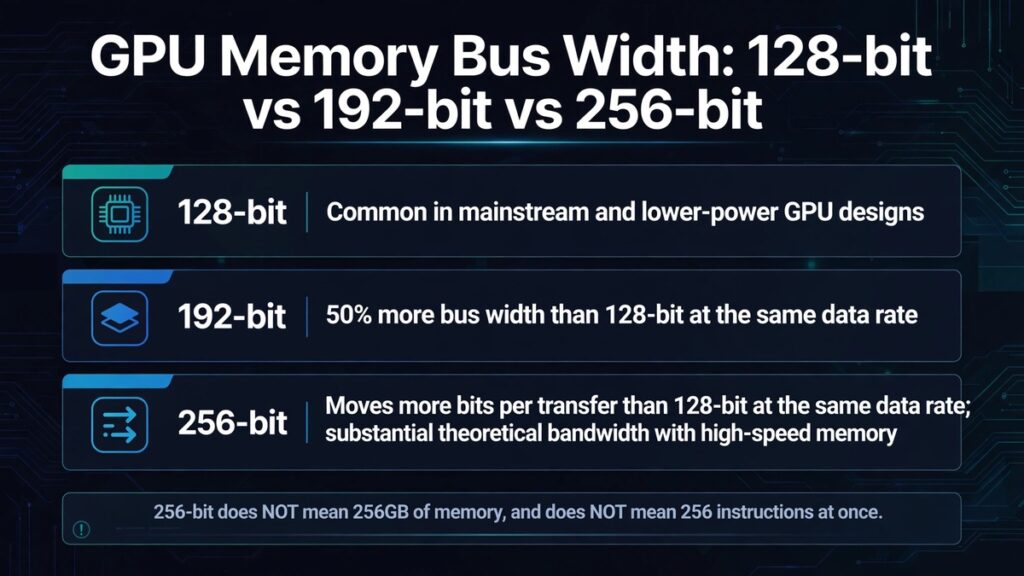
| Bus width | Compared with 128-bit | Article’s note |
|---|---|---|
| 128-bit | Baseline | Common in mainstream and lower-power designs |
| 192-bit | 50 percent more bus width at the same data rate | Provides more theoretical bandwidth with the same memory speed |
| 256-bit | More bits per transfer at the same effective data rate | Can provide substantial theoretical bandwidth, particularly when paired with high-speed memory |
Quick answer
A wider bus can increase theoretical bandwidth when data rate is held constant. But compare the full memory subsystem: data rate, cache, compression, capacity, architecture, and actual benchmarks.
The foundations
A modern graphics processor works with data that must be stored, fetched, transformed, and reused. Some data is accessed repeatedly; other data is needed only for a short rendering or compute stage. Memory controllers, caches, compression, and scheduling help manage these flows. The result is a hierarchy rather than one undifferentiated pool. Local VRAM provides high-throughput storage, caches keep selected data closer to compute units, and system memory can support some workloads through platform-managed pathways.
Capacity and bandwidth should be separated. Capacity determines how much data can remain resident. Bandwidth determines the rate at which data can be transferred. Cache can reduce external-memory traffic when access patterns allow reuse, but it does not replace the need for adequate capacity or bandwidth. The GPU's compute architecture determines how quickly it processes the data after it arrives.
What the bit width represents
The bus width is the aggregate number of data bits transferred across the memory interface in parallel. A 256-bit interface can move more bits per transfer than a 128-bit interface at the same effective data rate. The specification does not mean that the GPU has 256GB of memory or that it processes 256 instructions at once.
128-bit interfaces
A 128-bit interface is common in many mainstream and lower-power GPU designs. It can provide adequate bandwidth when paired with fast memory, efficient caching, and a workload that does not saturate the external interface. A card with a 128-bit bus should not be judged without considering its memory speed and architecture.
192-bit interfaces
A 192-bit interface provides 50 percent more bus width than a 128-bit interface, assuming the same data rate. Some GPU products use this configuration to balance bandwidth, board complexity, cost, and memory capacity. The actual performance depends on the GPU core and the rest of the memory subsystem.
256-bit interfaces
A 256-bit bus can provide substantial theoretical bandwidth, particularly when paired with high-speed memory. It may suit GPUs designed for higher performance tiers, but it is not a guarantee of superior frame rates. A newer GPU with a narrower interface may compete through faster memory, larger cache, compression, or more efficient architecture.
Bus width and bandwidth calculation
A simplified formula multiplies the effective data rate by the interface width and divides by eight. This produces a theoretical bandwidth figure in bytes per second. Use the actual data rate and bus width for the exact card. Do not infer bandwidth from the bus width alone.
Cache and compression
Large caches can reduce the frequency of external-memory requests when data is reused. Compression can reduce the amount of data transferred for supported resources. These features can help a GPU use its available bandwidth more effectively, which is why comparing bus width across unrelated architectures can be misleading.
Choosing a GPU
Compare game and application benchmarks at your target resolution. Review memory capacity, bandwidth, GPU architecture, cache, power, and price. If the card is for AI or content creation, check model and project requirements as well as gaming results. Bus width is a useful technical specification, not a purchase decision by itself.
How to evaluate the specification in practice
Begin with the exact GPU model and official product specification. Record memory capacity, memory type, bus width, effective data rate, stated bandwidth, cache information where available, and the architecture generation. Then identify the application and workload. A game at 1080p is not the same memory workload as a 4K game, a large 3D scene, or an AI model with a long context window.
Use benchmarks that match the intended task. For gaming, look for the same resolution, settings, game version, and comparable CPU platform. For AI, check model, quantization, framework, batch size, context, and runtime. For rendering or creator workloads, use project sizes and software versions representative of your own work. Synthetic bandwidth tests can describe a narrow aspect of the memory subsystem, but they do not replace application tests.
When comparing two cards, note whether they differ in more than one specification. If one has a different GPU chip, core count, power limit, cache design, or memory capacity, the observed performance gap cannot be attributed to one factor alone. Transparent comparisons identify the complete product and explain what the test can and cannot establish.
Common misconceptions
A larger capacity does not necessarily mean higher frame rates. A wider bus does not always mean a faster GPU. A newer memory generation does not automatically outperform every older implementation. Cache size cannot be compared without considering architecture and access behavior. Manufacturer peak bandwidth is not the same as the effective bandwidth achieved in every application.
Avoid adding dedicated VRAM and shared system memory together as if they were one equally fast pool. Also avoid assuming that a monitoring tool's allocation figure is the minimum memory required by the current workload. These misunderstandings can lead to poor buying decisions and misleading technical content.
Frequently asked questions
Is a 256-bit GPU always faster than a 128-bit GPU?
No. The GPU architecture, data rate, cache, compute resources, and workload determine overall performance.
Is 192-bit better than 128-bit?
At the same data rate it provides more theoretical bandwidth, but real performance depends on the complete design.
Can a 128-bit GPU run 1440p games?
Yes, depending on the GPU's overall performance, memory capacity, and game settings.
Does bus width affect VRAM capacity?
It is related to memory configuration, but bus width does not directly state the installed capacity.
What is more important, bus width or memory speed?
Both contribute to bandwidth. Compare the resulting bandwidth and the architecture rather than choosing one metric alone.
Conclusion
Bus width is one input to bandwidth. Compare the resulting memory subsystem and real workload performance instead of assuming a wider bus always wins.
The best interpretation of a GPU specification combines the hardware design with the workload and independent measurements. Use manufacturer documentation for exact specifications, understand what each metric represents, and compare complete systems under consistent conditions. That approach turns technical numbers into useful buying and engineering decisions.









