NVIDIA GPU vs AMD GPU for Local AI: VRAM and Software Considerations
Introduction
Choosing a GPU for local AI involves more than comparing memory capacity or theoretical compute performance. Software support can determine whether a model runs easily, which optimizations are available, and how much setup is required. NVIDIA and AMD both offer capable graphics hardware, but their software ecosystems, supported frameworks, drivers, and application compatibility differ. The right choice depends on the exact AI tools and models you intend to use.
Graphics memory is a finite working space, but the way an application uses it is shaped by its engine, data structures, runtime settings, and hardware. A useful guide must therefore explain both the general principle and the conditions that can change the outcome. The same GPU can behave differently after a software update, with a different model or game scene, or when another application is using the graphics processor.
This article focuses on practical understanding rather than a universal rule. It explains the terminology, identifies the variables worth checking, and provides a repeatable approach for evaluating a real system. Where a result depends on a specific application, that dependency should be made explicit instead of turning one observation into a claim about every workload.
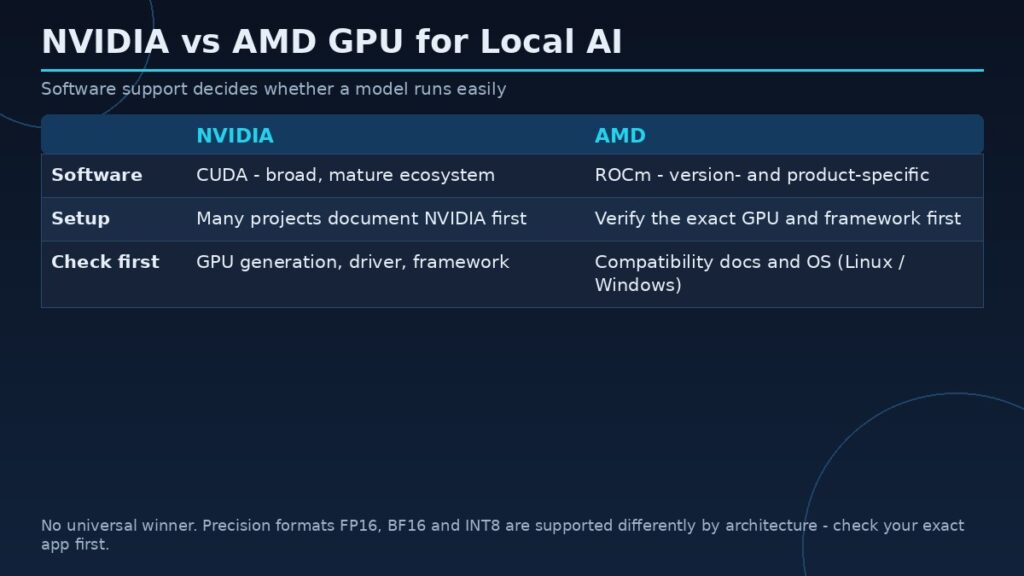
| Aspect | NVIDIA (CUDA) | AMD (ROCm) |
|---|---|---|
| Software ecosystem | Mature ecosystem of libraries, examples, and third-party integrations; many AI projects document NVIDIA setup paths first | Ecosystem for GPU computing on supported AMD hardware; compatibility is version- and product-specific |
| Operating system | Support varies by generation, driver, and framework | Support can differ between Linux and Windows |
| What to check before buying | Official compatibility lists for the exact card, driver, framework version, and operating system | Verify the exact GPU appears in the relevant compatibility documentation |
Quick answer
There is no universal winner. NVIDIA often has broad support in many AI tutorials and applications through CUDA, while AMD can be suitable when the specific ROCm or alternative software stack supports the GPU and workload.
Key concepts
Before changing hardware or settings, distinguish capacity from allocation and performance. Capacity is the physical amount of local graphics memory installed on the card. Allocation is the amount an application or driver has reserved or committed at a particular time. Active working-set demand is the data that must be available for the current workload to proceed efficiently. Monitoring tools can expose useful clues, but they may report different metrics and should not be treated as interchangeable.
Also distinguish memory capacity from bandwidth and compute throughput. Capacity determines how much data can reside locally. Bandwidth describes the rate at which data can move between memory and the GPU. Compute throughput describes how quickly the GPU can execute operations. A workload may be limited by any one of these factors, or by the CPU, storage, cooling, power limit, or software implementation.
Why software support matters
AI frameworks rely on GPU backends, kernels, libraries, and drivers. A fast GPU is of limited use if the required application does not support its architecture or operating system. Check official compatibility lists for the exact card, driver, framework version, and operating system. Community workarounds can be useful but should not be confused with officially supported configurations.
NVIDIA and CUDA
CUDA is widely used in GPU computing and has a mature ecosystem of libraries, examples, and third-party integrations. Many AI projects document NVIDIA setup paths first, which can make installation and troubleshooting more straightforward. Support still varies by GPU generation, driver, framework, and precision format. Do not assume every CUDA application supports every feature on every NVIDIA card.
AMD and ROCm
ROCm provides an ecosystem for GPU computing on supported AMD hardware. Compatibility is version- and product-specific, and support can differ between Linux and Windows environments or between framework releases. Before buying, verify that the exact GPU appears in the relevant compatibility documentation and that the intended AI application supports the required backend.
VRAM capacity and model fit
Both vendors offer products with different memory capacities. For local LLMs, image generation, and large 3D or AI workloads, capacity determines which models and configurations can fit locally. Estimate model weights, KV cache, batch size, and runtime overhead. A card with more memory may support a larger workload, but compute performance and software kernels still influence speed.
Precision and kernel support
AI applications may use FP16, BF16, INT8, or specialized quantized formats. Availability and performance depend on GPU architecture and software support. A format that is efficient on one vendor’s hardware may have a different performance profile on another. Check the framework’s supported operations and benchmark the exact model rather than extrapolating from peak specification figures.
Single GPU, multiple GPU, and system design
Multi-GPU configurations introduce additional questions: whether the application supports splitting layers or tensors, how GPUs communicate, whether memory is balanced, and whether the power supply and case can handle the cards. Nominal VRAM totals do not automatically become one shared pool. PCIe lanes, interconnect support, cooling, and physical spacing can affect the result.
A sensible purchasing checklist
List the exact AI applications and operating system first. Confirm GPU compatibility, supported driver versions, required libraries, model formats, and known limitations. Then compare VRAM capacity, compute performance, memory bandwidth, power draw, cooling, price, and upgrade options. Prefer a supported configuration over a theoretically faster card that requires fragile workarounds.
A step-by-step way to investigate
First, write down the exact system configuration. Include the graphics card, memory capacity, driver, operating system, CPU, system RAM, storage, and application version. Record the workload and its settings. In a game, include resolution, texture quality, ray tracing, upscaling, and the scene being tested. In an AI or workstation task, include the model or project, precision, batch size, context length, plugins, and offloading options.
Second, create a baseline using a repeatable task. Close unnecessary background applications, allow the workload to settle, and repeat the same action several times. Capture performance, memory allocation, system RAM use, GPU utilization, and any visible errors or quality changes. Do not rely on one short run. A background update or first-time shader compilation can distort a measurement.
Third, change one setting at a time. This is essential. If several options are changed simultaneously, the cause of an improvement or regression cannot be identified. Save the original settings, test the new configuration, and restore the baseline before testing another variable. When possible, use logs or frame-time captures instead of relying only on a screenshot.
Finally, report what the test does and does not prove. A single application version and one system configuration cannot establish a universal hardware requirement. Explain the test environment, disclose limitations, and distinguish measured results from estimates. This is especially important when publishing advice that readers may use to spend money or change a production workflow.
Common pitfalls
A common pitfall is assuming that a high allocation reading proves the card is out of memory. Software may reserve resources for caching, and different tools may expose dedicated usage, shared usage, committed memory, or budget information. Another pitfall is assuming that more VRAM automatically makes a GPU faster. Additional capacity can prevent a capacity-related problem, but it does not increase the number of shader cores or guarantee higher bandwidth.
A third pitfall is ignoring software changes. Drivers, game patches, AI frameworks, model formats, and operating-system updates can change memory behavior. Record versions and dates, and retest important claims after substantial updates. Avoid undocumented registry edits or utilities that promise to manufacture additional dedicated VRAM; software cannot change the physical memory installed on a discrete graphics card.
Frequently asked questions
Is NVIDIA better for local AI?
NVIDIA has broad CUDA support in many projects, but the best choice depends on the exact application and supported hardware.
Can AMD GPUs run LLMs?
Yes, supported AMD GPUs can run some local AI workloads through compatible software stacks. Verify the exact card and framework.
Does more VRAM matter more than brand?
Memory capacity is important for model fit, but software support and compute performance also matter.
Can I use two GPUs for one model?
Some frameworks support multi-GPU distribution, but not all applications do, and memory is not automatically pooled.
Should I buy based on benchmark charts?
Use benchmarks that match your model, quantization, framework, driver, and operating system. Generic peak-performance charts may not predict your application.
Conclusion
Choose the vendor whose software stack supports your exact applications reliably. Then compare VRAM, compute, bandwidth, power, and price within that compatible set.
The most dependable approach is to define the workload, measure it under controlled conditions, and interpret memory readings alongside performance and system behavior. Use manufacturer documentation for specifications, application documentation for supported settings, and repeatable tests for performance claims. That produces advice that is both more accurate and more useful than a one-number rule.









