8GB vs 12GB VRAM in Ray Tracing: What Changes?
Introduction
Ray tracing can increase the complexity of a game's rendering workload, but its memory cost is not identical in every engine. A comparison between 8GB and 12GB graphics cards should examine more than a single VRAM overlay. Ray-traced effects may require additional scene data, acceleration structures, render targets, denoising resources, and other intermediate buffers. The exact footprint depends on the implementation, resolution, quality preset, and GPU architecture.
This guide is designed to answer the practical question behind the headline, explain the technical principles involved, and give readers a repeatable way to evaluate their own hardware. Graphics memory is often discussed as if it were a single performance number, but real workloads are more complicated. The amount of memory installed, the amount currently allocated, the amount actively needed, the speed of the memory subsystem, and the work performed by the GPU core are related but distinct factors.
A useful analysis starts by identifying the workload. A game, an AI model, a 3D scene, and a video-editing timeline can use the same graphics card in very different ways. Each application creates its own resource footprint and responds differently when memory becomes constrained. The same capacity can be comfortable in one task and limiting in another. For that reason, this article avoids universal claims and explains which variables should be checked before making a decision.
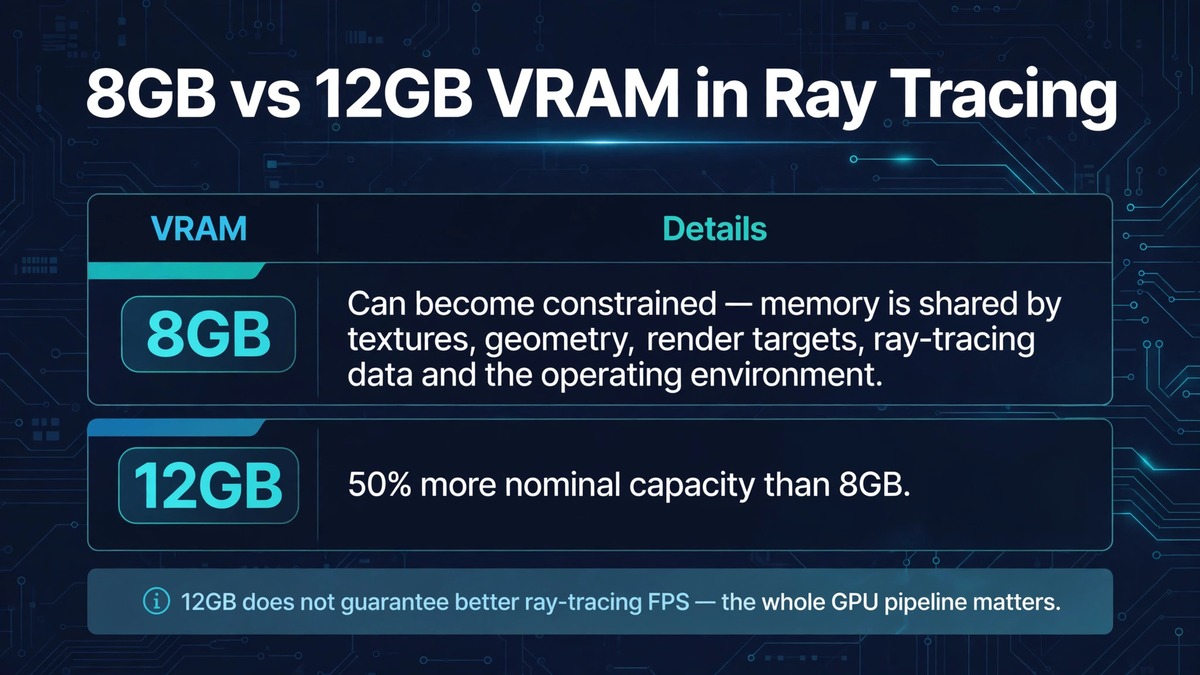
| Aspect | 8GB | 12GB |
|---|---|---|
| Nominal capacity | Baseline | 50 percent more nominal capacity than 8GB |
| Memory budget | Must share its budget among textures, geometry-related resources, render targets, ray-tracing data, and the operating environment | More room for the working set; may allow higher texture settings in a memory-constrained scenario |
| Ray-tracing FPS | Depends on compute and ray-tracing hardware, not capacity alone | No guarantee of a higher frame rate |
Quick answer
Choose the card with the stronger complete ray-tracing performance at your target settings. Treat additional VRAM as useful headroom, not a substitute for ray-tracing compute capability.
The central rule is to measure the workload you actually run, not to assume that a specification or monitoring number tells the whole story. Where possible, compare equivalent settings, record repeatable measurements, and separate capacity limits from compute, bandwidth, CPU, storage, and software limitations.
What ray tracing adds to a rendering pipeline
Traditional rasterization determines visible surfaces through a series of geometry and pixel operations. Ray tracing adds calculations that simulate how rays interact with scene geometry and materials. Real-time implementations often combine rasterization and ray tracing rather than replacing the entire pipeline. The additional structures and buffers can consume memory, but the precise amount depends on the engine and which effects are enabled.
Why 8GB can become constrained
An 8GB card may have to share its memory budget among textures, geometry-related resources, render targets, ray-tracing data, and the operating environment. If the total working set becomes too large, the game may stream assets more frequently or adjust resource residency. Symptoms can include inconsistent frame times or texture behavior, but these symptoms are not unique to VRAM limits and must be investigated.
What 12GB changes
Twelve gigabytes offers 50 percent more nominal capacity than 8GB. This can provide more room for the game’s working set and may allow higher texture settings in a memory-constrained scenario. It does not guarantee a higher frame rate because ray tracing also places heavy demands on compute units and specialized acceleration hardware. A GPU can have ample memory and still be too slow for a particular ray-tracing preset.
Resolution and ray-tracing quality
Higher resolution increases pixel-related workload and can enlarge some render targets. More demanding ray-tracing presets may also increase the amount or complexity of data processed. Test resolution and ray-tracing quality separately so that the cause of a change is visible. Upscaling can reduce rendering workload, but it does not necessarily reduce every memory resource in the same proportion.
How to benchmark responsibly
Use the same scene, game patch, driver, CPU, system memory, and settings. Record the exact ray-tracing options, resolution, upscaling mode, and frame-generation status. Capture average FPS, low-percentile performance, frame-time traces, and visual observations. Run a rasterized baseline and a ray-traced test. If only one card stutters, investigate whether lowering textures or ray-tracing quality changes the behavior.
Interpreting results
Do not conclude that a memory capacity caused a performance gap when the cards also differ in GPU architecture or ray-tracing hardware. Explain the whole configuration and describe the finding as a comparison of those products. Memory allocation near capacity is a clue, not proof. Stronger evidence comes from repeatable behavior that changes when memory-heavy settings are adjusted.
A practical evaluation workflow
Start by documenting the exact hardware and software configuration. Record the GPU model, installed memory capacity, driver version, operating system, application version, CPU, system memory, and storage device. In a laptop or compact system, also note power mode and thermal conditions because those can change sustained performance. For a game, write down resolution, texture quality, ray tracing, upscaling, frame generation, and the exact scene or benchmark route. For an AI workflow, record model name, quantization, context length, batch size, framework, and whether layers are offloaded to CPU.
Next, establish a baseline. Close unnecessary applications, allow the workload to reach a steady state, and repeat the same task several times. Record average performance as well as low-percentile behavior or completion time. Capture memory allocation and system RAM use, but do not interpret either number alone. If the application exposes logs, save them. A screenshot is useful for documenting settings, while a CSV or frame-time trace is better for later comparison.
Change one variable at a time. If you change resolution, texture quality, batch size, model quantization, and driver version together, it becomes impossible to know which change produced the result. A controlled test can reveal whether a setting affects memory capacity, compute load, bandwidth, or simply image quality. Repeat the test after each change and note any visual or functional differences.
Finally, report the limitations. State whether the result came from a built-in benchmark, a repeatable manual route, a synthetic test, or a single real project. Explain whether the test was repeated and whether the measurement tool reports allocated, reserved, or actively used memory. Honest methodology makes an article more useful than a confident headline supported by an unexplained number.
Common mistakes and misleading conclusions
One common mistake is treating memory allocation as proof of memory exhaustion. Applications may reserve unused capacity for caching, and monitoring utilities do not all report the same metric. Another mistake is assuming that more capacity automatically increases performance. Extra memory helps when the workload needs it; it does not make shader cores faster or increase the speed of a narrow memory bus.
A third mistake is comparing different graphics cards as though memory capacity were the only difference. GPU architecture, core count, memory bandwidth, power limits, cooling, and driver maturity can all affect results. If two products differ in several ways, describe the comparison as a product-level test rather than a controlled memory-capacity experiment.
It is also easy to overlook software versions. Game patches can change asset streaming, shader compilation, and graphics settings. AI frameworks can change memory allocation strategies between releases. A result should therefore include a date and version information, and older findings should be retested before being presented as current advice.
Frequently asked questions
Does ray tracing use more VRAM?
It can. Additional scene structures and rendering resources may increase memory use, but the amount varies by game and implementation.
Is 8GB enough for ray tracing?
Some games and settings may work, while demanding combinations can require compromises. Check independent tests for the exact GPU and title.
Does 12GB guarantee better ray-tracing FPS?
No. Ray-tracing hardware, shader throughput, bandwidth, and software optimization also determine performance.
Should I lower textures or ray tracing first?
Test each setting separately. Texture quality may be a direct memory control, while ray tracing changes both compute workload and resource use.
Can upscaling solve a VRAM shortage?
Upscaling can reduce rendering resolution and some pixel-related costs, but it is not a universal fix for all memory demands.
Conclusion
Choose the card with the stronger complete ray-tracing performance at your target settings. Treat additional VRAM as useful headroom, not a substitute for ray-tracing compute capability.
The most reliable decision comes from matching the hardware to a clearly defined workload and validating it with repeatable evidence. Use specifications to narrow the options, use measurements to understand actual behavior, and explain the limits of every comparison. That approach helps readers make a better decision without confusing a single memory figure with total graphics performance.









